
Smoke and carbon monoxide alarms are cheap, and the cost of getting them wrong isn't. Whether you're outfitting a new apartment building, replacing aging alarms across a set of rentals or stocking a weatherization program, the choices come down to what each alarm detects, how it's powered, whether the alarms talk to each other and where they go. This guide walks through each one, along with the codes and standards that apply.
Smoke Alarms vs. Carbon Monoxide Alarms
What Smoke Alarms Detect
A smoke alarm senses particles from combustion and sounds a loud alarm when it finds them. NFPA reports that working smoke alarms cut the risk of dying in a home fire roughly in half, which is why nearly every building code requires them in places where people sleep.
What Carbon Monoxide Alarms Detect
Carbon monoxide is an odorless, colorless gas produced when fuel doesn't burn completely. Furnaces, boilers, water heaters, gas ranges, fireplaces and cars running in attached garages can all produce it. You can't see or smell it, and early symptoms feel a lot like the flu. The CDC has estimated that unintentional, non-fire CO poisoning kills more than 400 people in the U.S. each year. A CO alarm measures the gas over time and sounds before levels become dangerous.
Combination Smoke and CO Alarms
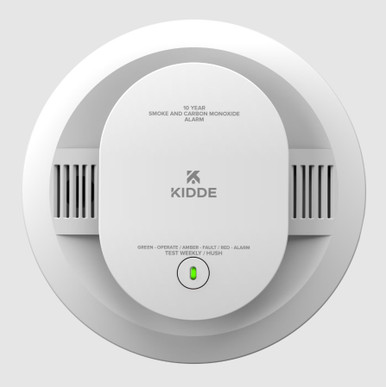
A combination smoke and CO alarm puts both sensors in one housing and uses different alarm patterns, or a voice, to tell you which hazard it found. You get half the holes in the ceiling and half the units to track. Separate alarms still make sense when the best spot for each one is different, or when only some units in a building need CO coverage. We also carry stand-alone CO alarms and smoke alarms.
Smoke Alarm or Smoke Detector?
People use the terms interchangeably, but fire codes don't. Under NFPA 72, a smoke alarm is a self-contained unit with its own sensor and sounder, which is what goes in homes and apartments. A smoke detector only senses smoke and has to be wired to a fire alarm control panel to sound an alarm. That difference matters when you're working in a building with a central fire alarm system.
Types of Smoke Alarm Sensors
Ionization Smoke Alarms
Ionization alarms react faster to fast, flaming fires, like a pan of grease or a wastebasket fire. They're usually the least expensive option, but older ionization models are also more prone to nuisance alarms from cooking.
Photoelectric Smoke Alarms
Photoelectric alarms react faster to slow, smoldering fires, like a cigarette dropped into a couch cushion. They also tend to be less bothered by cooking, which makes them a better pick for apartments where the kitchen is a few steps from the bedroom.
Dual-Sensor and Multi-Criteria Alarms
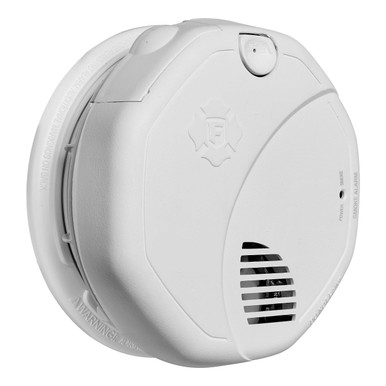
NFPA recommends having both ionization and photoelectric protection in a home. Dual-sensor alarms like the First Alert SM300-AC do that in one unit. Multi-criteria alarms, such as USI's Sensing Plus models, combine more than one type of reading to tell real fires from everyday smoke and steam.
Heat Alarms
Some spaces are just too dusty, steamy or smoky for a smoke alarm, like garages, attics and some kitchens. A heat alarm sounds when the temperature climbs past a set point or rises quickly, so it won't go off every time someone makes toast. The First Alert HD6135FB is a hardwired heat alarm with battery backup.
UL Standards and Certifications
Smoke alarms sold in the U.S. are tested to UL 217, and CO alarms are tested to UL 2034. The current edition of UL 217, the 8th, took full effect for manufacturers in June 2021. It added tests to make sure alarms can tell normal cooking smoke from a real fire, and it lined up with NFPA 72's requirement for nuisance-resistant alarms near cooking appliances. If you're installing anywhere close to a kitchen, check that the alarm is listed to the 8th edition. For CO alarms, the CPSC recommends models that meet UL 2034, which also requires an end-of-life warning.
Power Options for Smoke and CO Alarms

| Power type | How it works | Best for | Example |
|---|---|---|---|
| Replaceable battery (9V or AA) | Lowest cost up front. Batteries need changing about once a year. | Tight budgets and older buildings with no alarm wiring | First Alert SM601, Kidde 30CUDR |
| 10-year sealed battery | The battery lasts the life of the alarm and can't be removed. | Rentals, since tenants can't pull the battery. Required in some states. | First Alert SM610, Kidde 30CUD10 combo |
| Hardwired 120V with battery backup | Runs on building power, with a replaceable or 10-year backup battery for outages. | New construction and renovations where code calls for hardwired, interconnected alarms | Kidde FireX CUA10YFEX |
| Plug-in (CO) | Plugs into a standard outlet, usually with a backup battery. | Fast CO coverage with no drilling | USI MCN400 (CO and natural gas) |
Replaceable Battery Alarms
Battery-only alarms with replaceable 9-volt or AA cells are the cheapest way to get coverage, and they go up anywhere. The downside is upkeep. Batteries need to be swapped about once a year, and a dead or missing battery is one of the most common reasons an alarm fails when it's needed.
10-Year Sealed Battery Alarms
Sealed battery alarms have a lithium battery that lasts the life of the unit. When the alarm reaches the end of its life, you replace the whole thing. A growing number of states, including California and New York, now require battery-only smoke alarms to use a 10-year sealed battery, so check your state's rules before you order a case of 9-volt models.
Hardwired Alarms with Battery Backup
Hardwired alarms run on 120V building power and use a battery to keep working during outages. Building codes generally require hardwired, interconnected alarms in new construction and major renovations. When you replace an existing hardwired alarm, plan on replacing it with another hardwired unit.
Interconnected Smoke and CO Alarms
Interconnected alarms all sound when one goes off, so someone asleep in a back bedroom hears about a fire that starts in the kitchen. Building codes generally require interconnection in new construction, and NFPA recommends it in every home.
Hardwired Interconnection
Hardwired alarms connect through an extra wire run between units. Different brands generally won't interconnect with each other, so stick with one brand and model line per building. That also keeps mounting plates and spare stock simple.
Wireless Interconnection
Wireless alarms link to each other by radio, which saves running new wire through finished walls and ceilings in an existing building. First Alert's wireless line includes the SA520B hardwired bridge unit, which ties existing hardwired alarms to wireless ones, and the CO511B CO alarm, which announces where the problem is.
Switching Brands on Existing Wiring
Hardwired alarms plug into a wiring connector in the ceiling box, and each brand uses its own plug style. If you're replacing Kidde alarms with First Alert units, the First Alert ADK-12 adapter plugs are made for that change, so you don't have to rewire every box.
Where to Install Smoke and CO Alarms
Bedrooms, Hallways and Every Level
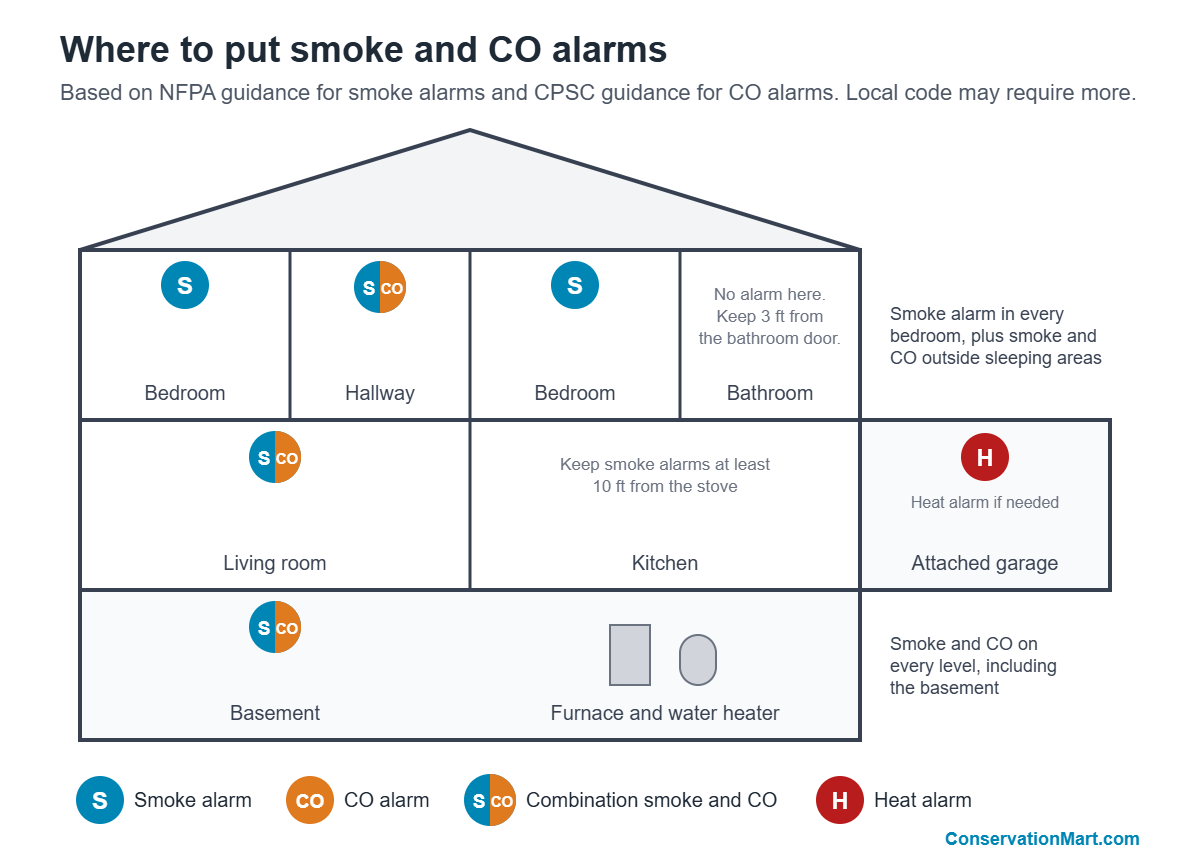
NFPA's guidance for homes is a smoke alarm inside every bedroom, another outside each sleeping area and at least one on every level, including the basement. In an apartment, that usually means one in each bedroom and one in the hallway that leads to them.
Kitchens, Bathrooms and Garages
Keep smoke alarms at least 10 feet from cooking appliances to cut down on nuisance alarms, and at least 3 feet from the door of a bathroom with a shower, since steam can set them off. Skip smoke alarms in garages and unheated attics, where dust and temperature swings cause problems, and use a heat alarm there if you want coverage.
Ceiling and Wall Mounting
Smoke rises, so alarms go on the ceiling or high on a wall. If you mount on a wall, the top of the alarm should be no more than 12 inches below the ceiling. Keep them away from ceiling fans, supply vents and windows, where moving air can push smoke away from the sensor.
CO Alarm Placement
The CPSC recommends a CO alarm on every level of a home and outside each sleeping area. Follow the manufacturer's instructions on height and distance from fuel-burning appliances, since mounting one right next to a furnace or water heater can cause false alarms. Combination units handle this easily, because the same spot outside the bedrooms works for both smoke and CO.
Features for Rentals, Multifamily and Commercial Buildings
Tamper-Resistant Alarms
In student housing and rentals, alarms get pulled down, covered up or emptied of batteries. Tamper-resistant models lock to the mounting bracket, and sealed battery versions can't be disabled by removing the battery. The First Alert PR710B is a photoelectric alarm with a tamperproof 10-year sealed battery.
Voice Alerts
Voice alarms say "fire" or "carbon monoxide" out loud along with the siren. That helps people react faster and tells them which problem they're dealing with, which matters with combination units. The Kidde Detect line and several First Alert models come in voice versions.
Digital CO Displays

A CO alarm with a digital display shows the current reading in parts per million. When a resident calls about an alarm, maintenance staff can see right away whether CO is actually present and how high it got. See the First Alert CO9B10D.
Strobe Alarms for Hearing-Impaired Residents
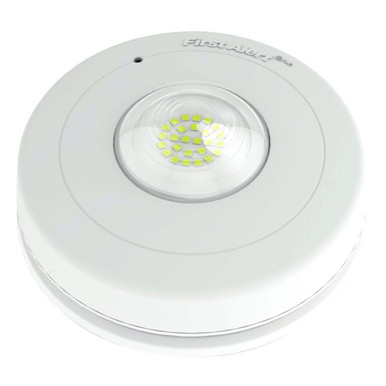
Accessible units need a visual signal along with the sound. The First Alert LEDSLED177 is a hardwired 177-candela strobe that flashes when connected smoke or CO alarms go off.
Explosive Gas and CO Alarms
In units with natural gas or propane appliances, an alarm that watches for gas leaks as well as CO covers both risks. The First Alert GCO1 and the plug-in USI MCN400 are two options.
Smoke and CO Alarm Rules for Landlords and Property Managers
In most states, landlords are responsible for installing working smoke alarms in rental units, and many states also require CO alarms in rentals that have fuel-burning appliances or an attached garage. Who handles testing and battery changes after move-in varies by state and lease. Because the rules differ so much, check with your state fire marshal or local building department before standardizing on a model, and keep a record of install dates and testing for each unit.
Testing, Maintenance and Replacement
Test every alarm once a month by pressing the test button. Keep them clean, since dust and cobwebs in the sensing chamber can cause false alarms or slow response, and a few seconds with a vacuum brush usually does it.
Replace smoke alarms when they're 10 years old. The manufacture date is printed on the back. CO sensors wear out too, usually somewhere between 7 and 10 years depending on the model, and units built to UL 2034 give an end-of-life warning. If an alarm chirps, it's either a low battery or that end-of-life signal, and the manual will tell you which. When you replace a whole building at once, write the install date on each alarm so the next round is easy to plan.
Buying Smoke and CO Alarms in Bulk
Pick one brand and model line per building and stick with it. That keeps interconnection, mounting plates and spare stock simple. Most of our alarms ship in cases of 4, 6 or 12, and case pricing is lower. A few extra units on the shelf cover failures and move-ins without a rush order.
Many weatherization programs require a CO alarm in homes with a fuel-burning appliance, so program buyers often stock combination units by the case. We carry alarms from First Alert, Kidde and USI. For large orders, use the Volume Quote Request button on any product page or fill out our quote request form.
Smoke and CO Alarm Buying Checklist
- Smoke and CO coverage anywhere there's a fuel-burning appliance or attached garage
- Photoelectric or dual-sensor alarms near kitchens, listed to UL 217 8th edition
- CO alarms listed to UL 2034
- Power source that meets your state's rules, with 10-year sealed batteries where required
- Interconnected, wired or wireless
- Tamper-resistant models for rentals and student housing
- Strobe alarms for accessible units
- Install dates written on every unit
Smoke and CO Alarm FAQs
How many smoke alarms do I need?
At minimum, one inside each bedroom, one outside each sleeping area and one on every level of the home, including the basement. Larger homes and long hallways may need more. Local code can require additional alarms.
Do I need a CO alarm if my building is all electric?
If there are no fuel-burning appliances, no fireplace and no attached garage, the risk of CO is low. Some state and local codes still require CO alarms in certain buildings, so check the rules where you're installing.
How long do smoke and CO alarms last?
Smoke alarms should be replaced every 10 years. CO alarms usually last 7 to 10 years depending on the model, and most current units chirp or display a message when they reach end of life.
Can I replace a hardwired smoke alarm with a battery-only one?
Usually not. If a building was required to have hardwired, interconnected alarms, code generally expects them to be replaced with the same type. A wireless interconnected system can be an option in some cases, so check with your local building department first.
Why does my smoke or CO alarm keep chirping?
A single chirp every minute or so usually means a low battery. On sealed battery and newer units, a chirp can also be the end-of-life warning that tells you to replace the alarm. The manual for your model explains which pattern means what.
Should smoke alarms be photoelectric or ionization?
NFPA recommends having both types of protection. Photoelectric alarms are better at smoldering fires and less prone to cooking false alarms, while ionization alarms react faster to flaming fires. Dual-sensor alarms give you both in one unit.
Shop our full selection of smoke, carbon monoxide and fire detectors, or pick up fire extinguishers while you're outfitting a building.